The daily standup is a tax. Here's what to run instead.
Fifteen minutes a day, times everyone, mostly to confirm nobody is on fire. Here is the async system that keeps the visibility and drops the meeting.
on this page3 sections
Standups are a coordination tax. Five people, fifteen minutes, every day, mostly to confirm nobody is on fire. Do the arithmetic and it stops looking small: one analysis pegs a single daily standup at $30,000 to $150,000 a year once you price in salaries and lost focus.
The meeting feels cheap because the cost is hidden. Nobody invoices you for it. But the time leaves anyway, and it leaves every single day.
aside:
The goal of a standup is visibility — who is doing what, and what is stuck. The meeting is one way to get that. It is not the only way, and it is one of the most expensive.
The fifteen minutes is not the real cost. The real cost is the crater it leaves in the day. A standup at 10am means nobody starts deep work at 9. Research on context switching consistently finds it takes around 23 minutes to fully refocus after an interruption — so a fifteen-minute meeting can erase the better part of an hour on either side.
Multiply that by a week, by a team, by a year. The standup is not a fifteen-minute line item. It is a daily tax on everyone's best working hours.
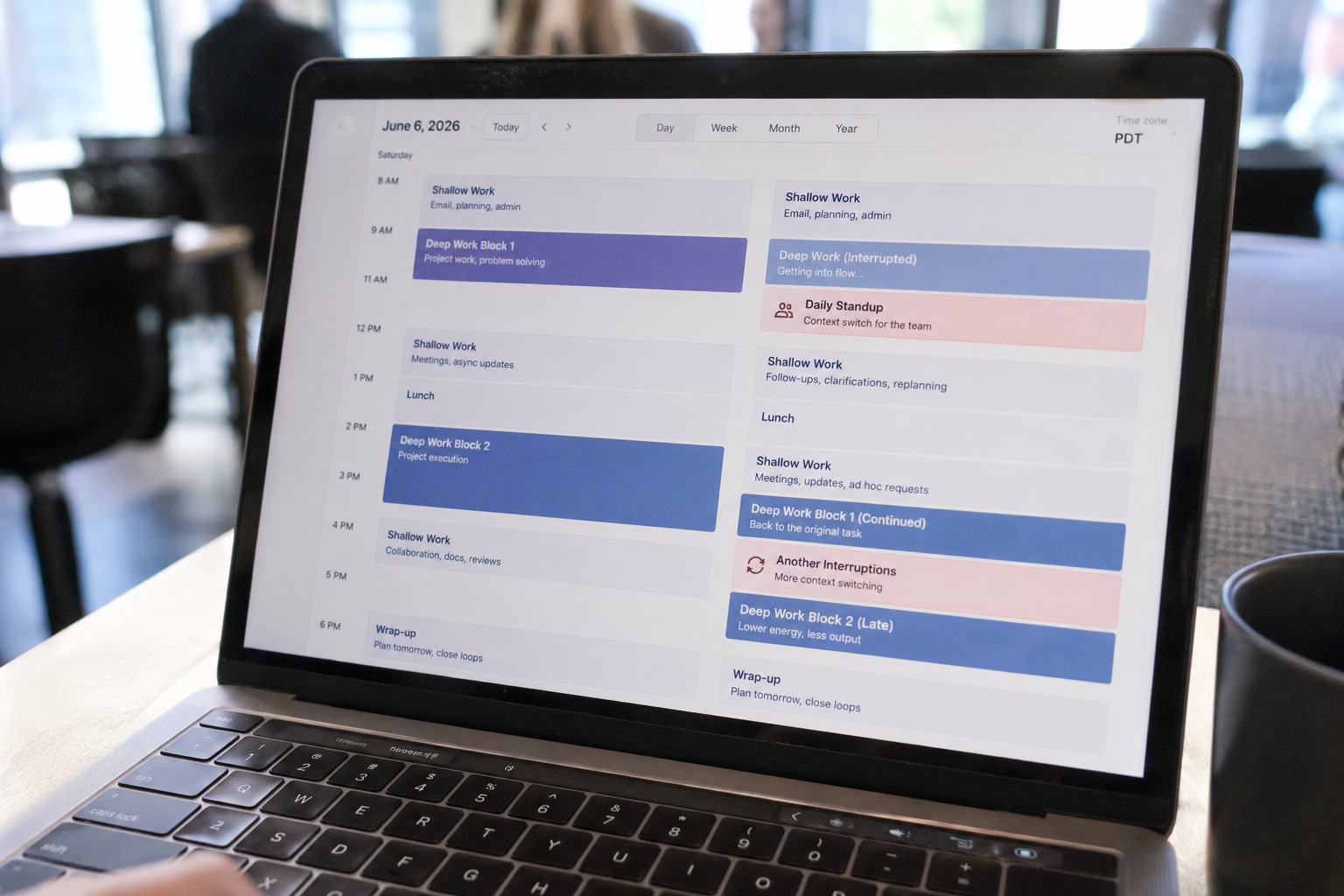
What a standup is actually for
Strip it down and a standup does three things: it surfaces what got done, what is happening next, and what is blocked. Two of those are broadcast — pure status, no discussion needed. Only the third, the blockers, occasionally needs a live conversation, and usually only between two people, not the whole room.
So most of the meeting is a group of people taking turns reading out information that could have been written down. The blocker that genuinely needs a decision gets the same five minutes as the update that needed zero.
— The case for async updatesStatus is broadcast. Blockers are conversation. Stop paying meeting prices to broadcast.
The async replacement has three parts, and none of them is a meeting. First, a short written update per person or team — shipped, in progress, blocked. Second, one channel where every update lands, so anyone can scan the whole team in two minutes on their own schedule. Third, a clear escalation rule: a real blocker pulls the two relevant people into a five-minute call, now, instead of waiting for tomorrow's standup.
That last part matters. Async does not mean slower. It means the broadcast goes to writing and the genuine conversations happen immediately, with the right people, instead of being queued for a daily ceremony.
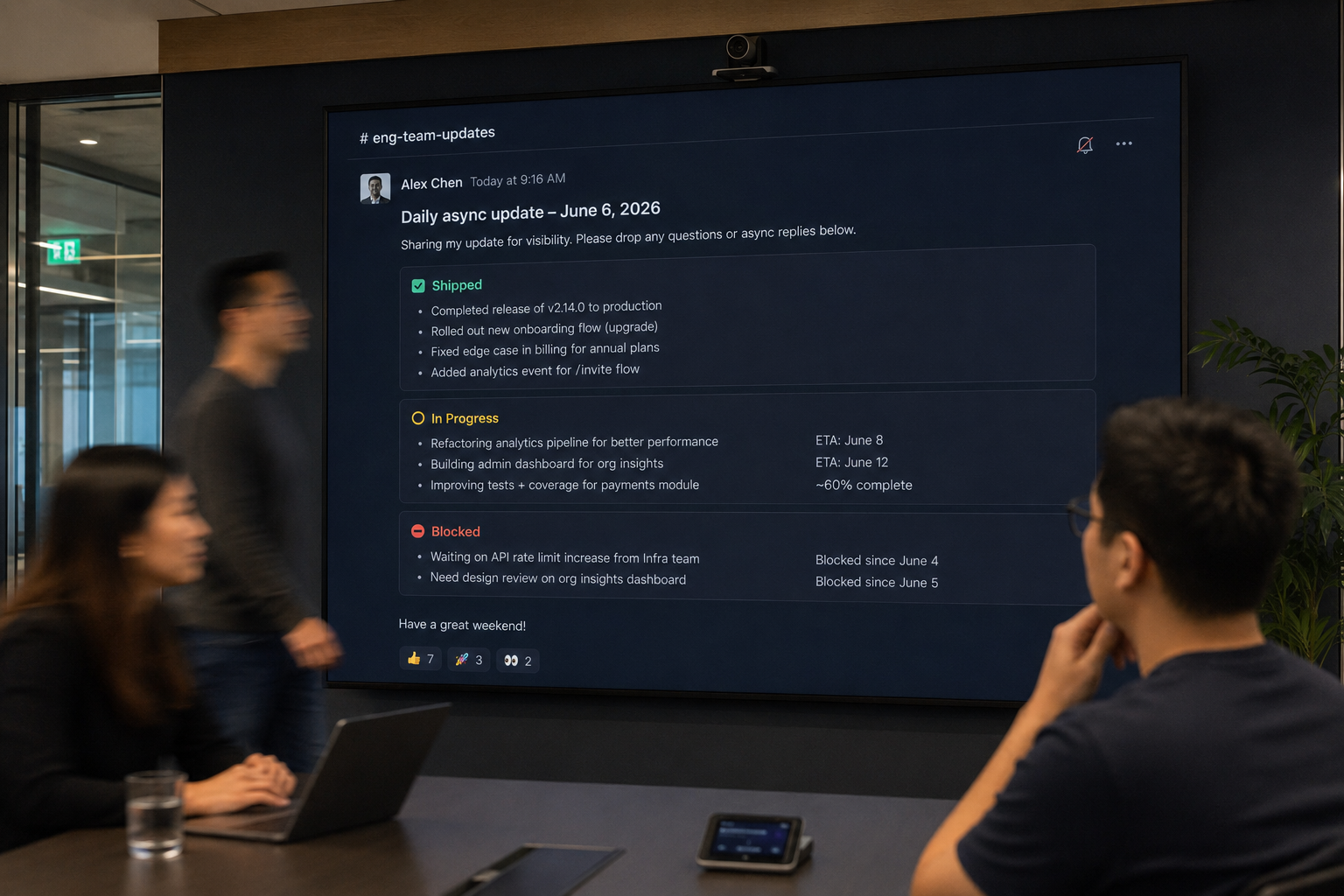
Make the update write itself
Async standups fail for one boring reason: writing the update is a chore, so people skip it, and the channel goes quiet. The fix is to stop writing updates from scratch. Most of what belongs in a status update already exists — the tasks that moved, the milestones that closed, the work logged this week.
That is the part worth automating. Tools like sprintrr generate a written status update from your project's actual activity and deliver it to Slack or email on a schedule you set. You review the draft before it goes out, so it stays accurate without becoming another daily chore. The point is not the tool — it is that the update should be a byproduct of the work, not a second job on top of it.
tip:
Try it for one sprint: kill the standup, open one updates channel, and write the escalation rule on the wall. Keep the calendar invite as a fallback. If nobody asks to bring the meeting back, you have your answer.
Common questions
When does a synchronous standup still make sense?
During an active incident, in the first days of a new team that has not built trust yet, or when a project is genuinely on fire and needs real-time coordination. The point is to make the meeting the exception, not the daily default.
Won't people just stop reading the async updates?
They will if the updates are long or scattered across five channels. Keep them short, keep them in one place, and make them signal-rich — shipped, in progress, blocked. A two-minute scan beats a fifteen-minute meeting only if it actually takes two minutes.
How do we handle real blockers without a daily meeting?
With an escalation rule. A blocker does not wait for tomorrow's standup — it pulls the two relevant people into a short call immediately. Async handles the broadcast; live conversation handles the exceptions, on demand.
Does this work across time zones?
This is where async wins outright. A written update posted on each person's own schedule does not require everyone to be awake at the same time, which a live standup does. Distributed teams often benefit the most.
Let the status update write itself
sprintrr turns your project's real activity into a written status update and delivers it to Slack or email on your schedule. Free to try.
// more from the journal