Two memos, one AI paragraph: the week tech layoffs got specific
On Tuesday Meta cut 8,000 jobs and Intuit cut 3,000. Both memos named the same reason. So did Cisco's two weeks earlier. The shape of the explanation matters more than the math — and the next twelve months will sort which CEOs were right.
on this page5 sections
This week the layoff notices stopped being vague. Meta cut 8,000 people the same week it reported record revenue of $56.31 billion and net income of $26.8 billion. Intuit cut 3,000 — 17% of its workforce — the same Tuesday. Cisco cut about 4,000 a few weeks earlier. Each CEO's memo named the reason in the same paragraph: AI.
Compare that to the 2022 round, when the script was overhired during the pandemic. The 2023 one — macro headwinds. The 2024 version — efficiency. Those were euphemisms for cost discipline. This week's memos are something else. They name a technology and a strategy as the cause, on the record.
That's the change worth tracking. Not the headcount — that's been visible on layoffs trackers all year. The change is rhetorical, and rhetoric in this industry is forward-looking. When a CEO says AI in a layoff memo, they commit publicly to a workforce shape they will have to defend in twelve months.
note:
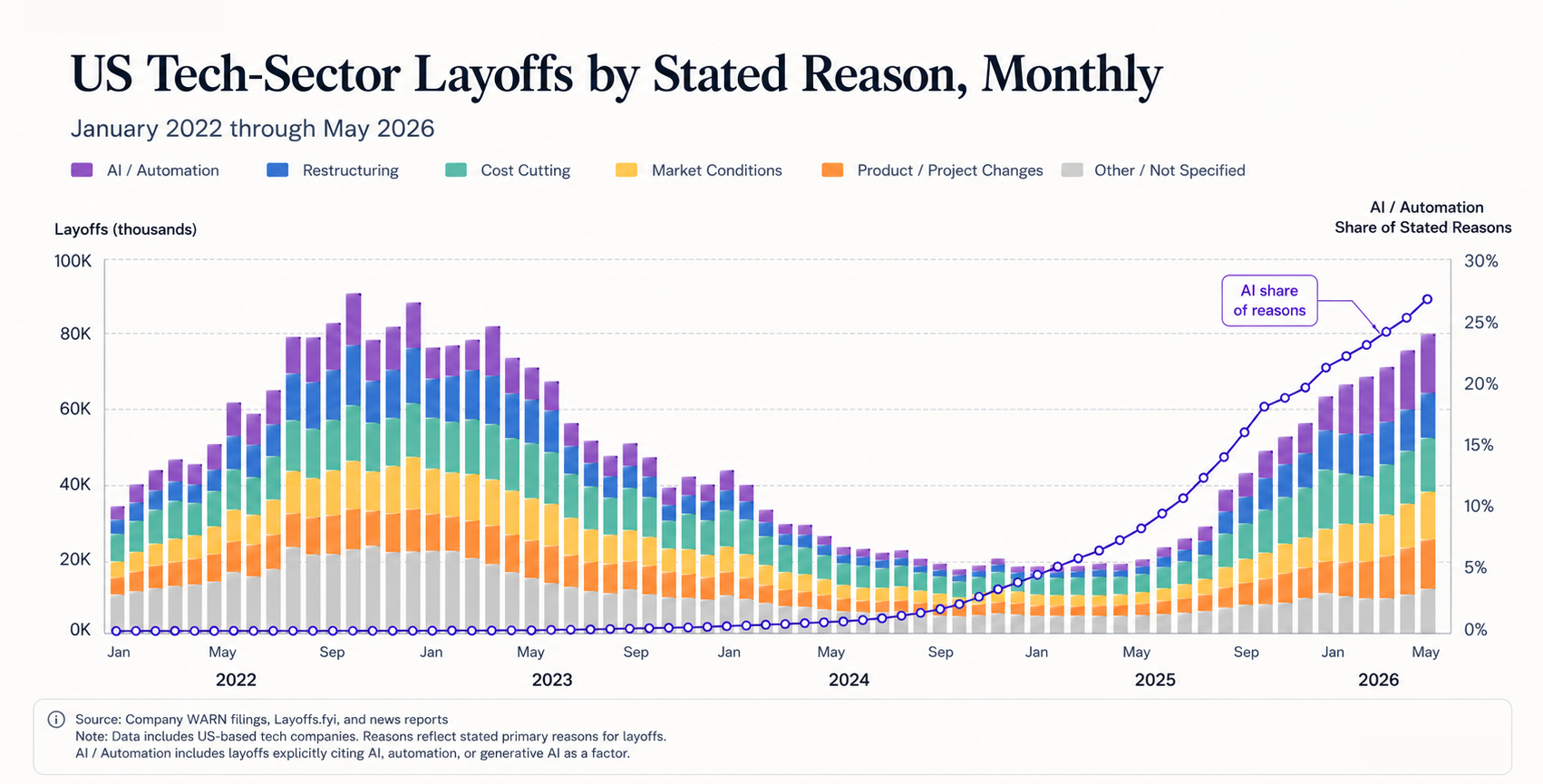
AI is not the cause of every cut this week. It is the named reason for more than one in four US job cuts, for the second month in a row. That's the signal worth examining — what gets named, and what doesn't.
The notices, in order
Meta — Tuesday, May 20. 8,000 layoffs, roughly 10% of the company. An additional 6,000 open requisitions cancelled. Approximately 7,000 employees reassigned into AI-focused roles. CFO Susan Li had guided AI capital expenditure for 2026 to between $115 billion and $135 billion at the prior earnings call. The memo from Chief People Officer Janelle Gale framed the cuts as the cost of funding that buildout. CEO Mark Zuckerberg's framing, per CNBC's reporting on the internal memo: success isn't a given in the AI race. Same week the company reported record quarterly revenue of $56.31 billion and net income of $26.8 billion.
Intuit — Tuesday, May 20. 3,000 layoffs, 17% of the global workforce of roughly 18,200. CEO Sasan Goodarzi's memo framed the cuts as a way to reduce complexity by simplifying the company's corporate structure and help it focus on AI efforts.
Cisco — earlier in May. About 4,000 layoffs. CEO Chuck Robbins: The companies that will win in the AI era will be those with focus, urgency, and the discipline to continuously shift investment toward the areas where demand and long-term value creation are strongest.
Year to date. Tech-sector layoffs have crossed 100,000 in 2026 on the conservative trackers, higher on the broader ones. Amazon, Block, Cloudflare, Microsoft, and Oracle have all cited AI refocus as a reason for cuts at various points this year.
What is actually driving this
There are three plausible explanations sitting next to each other in the same memo. Worth pulling them apart.
The first is real automation. Some functions — customer-support tier one, technical content writing, mid-rung software-engineering boilerplate, image production for marketing — have AI tools that are good enough to compress the team. That has been measurable since 2024. It is accelerating.
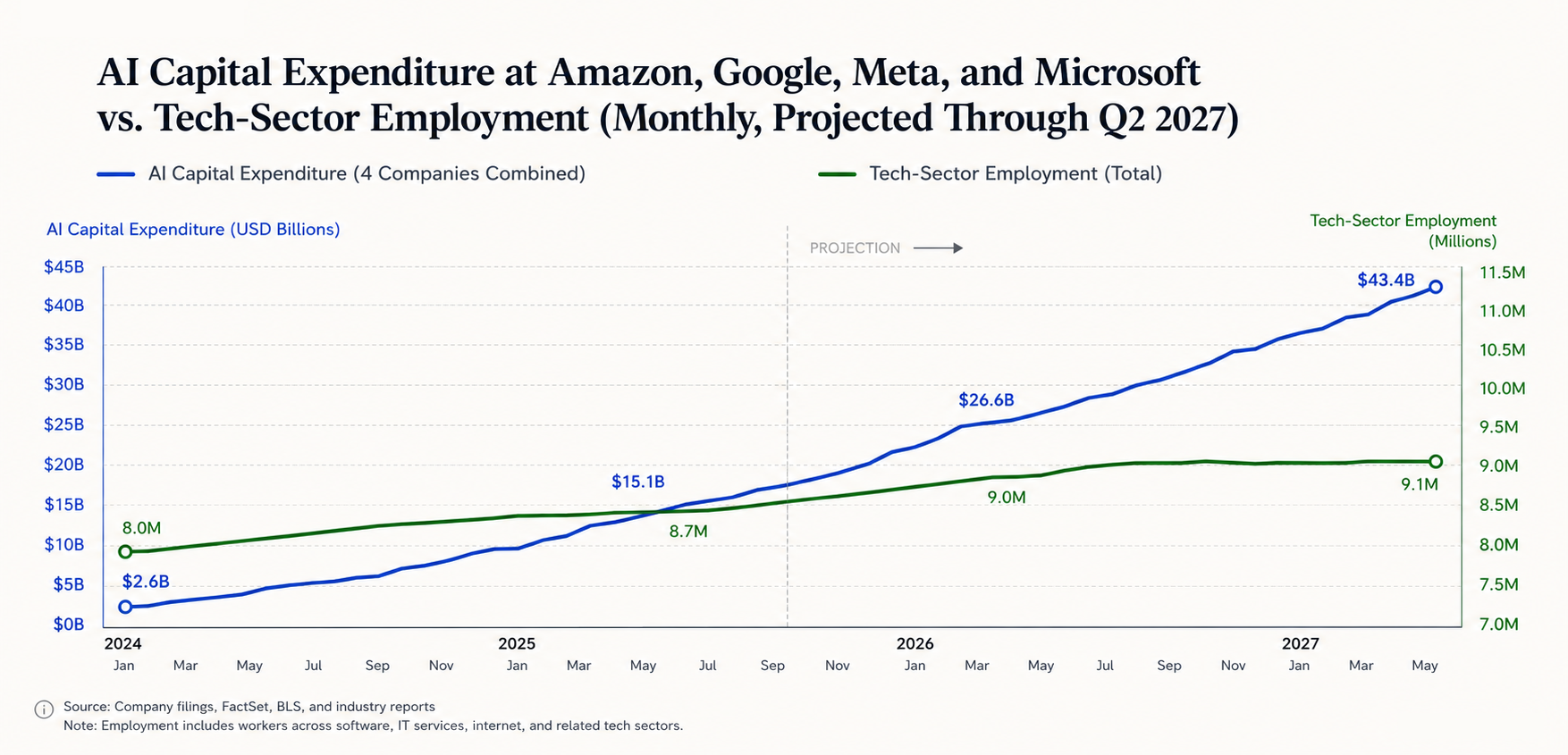
The second is the cost of buying the GPUs. Meta's $115 to $135 billion capex envelope, sitting next to Amazon, Google, and Microsoft's matching commitments, lands the four-company total around $650 billion for 2026. That money has to come from somewhere. Payroll is the largest controllable line on a tech company's P&L.
The third is post-ZIRP discipline that never finished. Tech hired aggressively from 2020 through 2022 on zero-interest-rate money. The correction has been running in waves since November 2022. AI is now the framing for cuts that would have happened regardless. Apollo's chief economist Torsten Slok put it bluntly: AI is everywhere except in the incoming macroeconomic data. The BLS productivity numbers have not yet caught up to the CEO rhetoric.
A reasonable cut of this week's announcements: roughly half are credibly AI-attributable in the way the CEOs claim. Roughly half are capex pressure or finishing the 2022 correction, with AI as the more forward-looking name on the form.
What we see from inside the category
We build AI tools for project planning. That puts us inside the category these memos are about. It does not absolve us, and it does not make us the cause — sprintrr does not lay anyone off when a customer plans a sprint with it instead of running a Wednesday meeting. What we will say is this: the productivity gains the CEOs are pricing in are real for some workflows and oversold for others, and the gap between those two cases is where the next year of pain will concentrate. The companies pricing in gains they do not yet have are going to recut in Q3 and Q4. The workers being recut are not, in most cases, replaceable by current models for the full scope of their roles. Both things are true at the same time.
— Torsten Slok, Chief Economist, Apollo Global ManagementAI is everywhere except in the incoming macroeconomic data.
Five predictions for mid-2027
A reader in mid-2027 should be able to check each of these.
1. Knowledge-work hiring stays net-negative in tech through 2026, roughly flat in the first half of 2027. Layoffs.fyi and the Challenger report will show declining year-over-year hiring intentions through Q1 2027, then stabilization by Q2 as the capex cycle's reinvestment starts paying out.
2. At least one Fortune 500 company will quietly walk back AI-attributed cuts. They will rehire — under a different title, in a different function — workers in roles where the AI tools turned out not to cover the full scope. This will happen by Q2 2027 and will not be announced as a reversal.
3. AI-leveraged headcount becomes a stated KPI in S-1 filings and shareholder letters. At least three publicly traded tech companies will publish a metric that explicitly relates AI tooling spend to output per employee by year-end 2026. Investors will price it.
4. The US will not pass binding federal AI labor legislation by mid-2027. State-level rules will keep accumulating — New York, California, Colorado. The EU AI Act enforcement timeline will produce its first material fines, but not ones retroactively tied to the 2026 layoff wave.
5. Mid-career wage compression will become measurable in BLS data for software engineering and marketing operations. Junior salaries will hold or rise — the bottom rung is harder to automate at deployment scale. Senior salaries will hold. The middle is where the squeeze lands, and it will show up as flat nominal pay against an inflationary backdrop.
What does not compress
Three slices of knowledge work do not compress under current models, even generously interpreted.
Work where the bottleneck is taste, not speed — strategy, brand judgment, product framing. The model can produce 50 candidate framings in a minute; choosing the right one is still a human bet, and the bet is the job.
Work where the cost of being wrong is asymmetric — legal, medical, safety-critical engineering, financial reporting. Models can draft. The accountability sits with a named human, and that does not change in twelve months.
Work where the value is in the relationship — sales for complex products, executive coaching, anything where the buyer wants to look the seller in the eye. The model can prepare the meeting. It does not show up to it.
Everything else is at some level of compression. Some workflows compress to zero. Some compress by twenty percent and the role feels the same. Most sit somewhere in between, and the next twelve months will sort them.
aside:
If your role is in that somewhere in between band — the productivity gain is real, the role is not eliminated — your job for the next year is to make the gain visible. The CEOs writing these memos are responding to legibility, not just to capability.
Plan deliberately.
Sprintrr turns a brief into a structured plan in about 60 seconds. Build it, defend it, ship it.
// more from the journal